
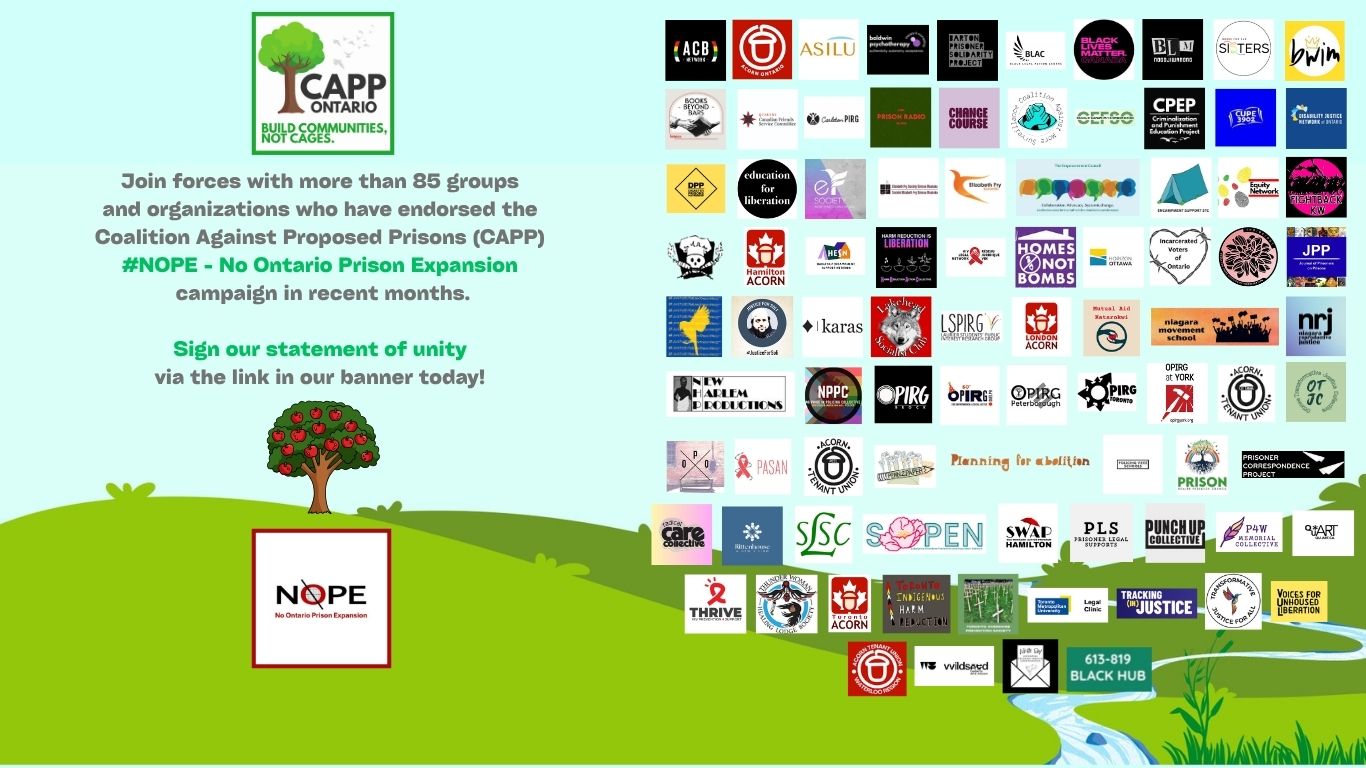
We invite you to #BuildCommunitiesNotCages by endorsing our #NOPE campaign’s Statement of Unity demanding a province-wide jail construction moratorium. Stand with us to stop ill-conceived and unnecessary jail expansion projects, while instead funding community-based initiatives that actually improve our collective well-being and safety by addressing social inequalities in housing, health and mental health care, employment and income support, education and other vital human needs that are vastly underfunded.
Check out our latest video #NOPE on prison expansion:
Sign here
#NOPE Statement of Unity
The Coalition Against Proposed Prisons (CAPP) has recently uncovered the Ministry of the Solicitor General’s three-phase prison building plan to massively expand Ontario’s provincial jail system by adding over 50% more prisoner beds by 2050. This secret plan to radically increase the capacity to imprison more people makes no sense from a public policy perspective and will do more harm than good, while costing Ontario taxpayers billions of dollars that could be better spent on less costly and more effective community infrastructure and supports to improve public safety.
While prison expansion is proven to be tough on taxpayers, not on crime, the SolGen plan aims to increase the province’s jail capacity, which is currently around 10,000 beds, to as high as 15,670 beds by 2050. The records we have obtained through a Freedom of Information request show that that the Ministry plans a second phase of jail expansion that includes 1,500 more spaces for imprisoned people to be built from 2033 to 2041, along with a third phase that includes 2,000 to 3,000 more jail beds by 2050.
Since taking office in June 2018, Premier Doug Ford’s government has continually sought to expand Ontario’s provincial jail system. The Ford government has already announced prison building and expansion plans that will add over 2,500 beds, while costing Ontario taxpayers $3 billion for construction alone. Including new 50-bed units at the Kenora Jail and Thunder Bay Correctional Centre that have already opened, the repurposing and reopening of intermittent centres at the Elgin-Middlesex and Toronto South Detention Centres totalling an additional 430 beds, and a new 345-bed Thunder Bay Correctional Complex that is currently being built and is now planned to have an additional 117 spaces through “bed optimization” (i.e. double- and triple-bunking).
The Government of Ontario has also earmarked funds for other new jail infrastructure projects, most of which are set to be built in staunch Progressive Conservative ridings. The projects include:
- Adding 610 beds through the construction of 122-bed prison domes / “tensile membrane structures” at the Central East Correctional Centre in Lindsay, Central North Correctional Centre in Penetanguishene, and three other existing facilities to be announced at a later date;
- Adding 300 beds through what were originally announced as 50-bed unit expansions but are now 100-bed expansions to the Niagara Detention Centre in Thorold, the Vanier Centre for Women in Milton, and the Cecil Facer Youth Facility that is set to be converted into a women’s jail in Sudbury;
- Expanding the Quinte Detention Centre in Napanee through the construction of a 91-bed unit for women, including several triple-bunked cells;
- Expanding the St. Lawrence Valley Correctional and Treatment Centre in Brockville through an addition of 25 beds for women;
- Replacing the 54-bed Brockville Jail with a 270-bed Brockville Correctional Complex; and
- Building a 235-bed Eastern Ontario Correctional Complex on the grounds of the former Kemptville Agricultural College that includes prime farmland, heritage farm buildings, floodplain and a Rideau River watershed creek.
Despite previously framing the new jail infrastructure as a “modernization” initiative, the Ministry of the Solicitor General is also considering reopening pre-Confederation era jails, including one in Walkerton that currently does not have plumbing and one in Brantford, which according to inspectors’ reports has never met operational standards.
At a time when more than 85% of Ontario’s provincial prisoners are awaiting their day in court and thus presumed innocent until proven guilty, Ford has vowed to “build as many jails as we need to put these criminals behind bars for a long time”. Under the mantra “jail, not bail” his government has fanned the flames of a moral panic around post-pandemic and inflation-context increases in car thefts and interpersonal violence to line the pockets of their friends in construction and finance who make millions through human cage building.
Anyone looking at centuries of evidence knows that imprisonment is a costly, ineffective, inhumane, and unjust approach to enhancing community well-being and safety.
The Coalition Against Proposed Prisons (CAPP) has launched a campaign – No Ontario Prison Expansion | #NOPE – demanding the Ontario government adopt a jail construction moratorium and to #BuildCommunitiesNotCages. Here’s why.
1) Imprisonment is extremely expensive and diverts funding away from measures that actually enhance community well-being and safety. A single prison can cost upwards of a billion dollars to build, finance, maintain and operate. For instance, the new Thunder Bay Correctional Complex is estimated to cost $1.2 billion over the life of a 30-year public-private-partnership. In the same region, nearly $100 million was spent on expansions to existing, older jails. These public funds are being needlessly spent when more inexpensive and effective means exist to prevent violence and other forms of law-breaking. Moreover, these projects can take years to complete. However, community initiatives that prevent violence are underfunded right now. These unnecessary jail projects will absorb funds that could be spent on immediate needs such as affordable housing, community health, mental health services, diversion measures, and more efficient restorative and transformative justice projects.
2) If they build it, they will fill it. Given that Ontario’s provincial jail system is already very large with 25 facilities confining more than 11,000 people, and a remand population of over 85%, the need to push back against the expansion of sites of human caging is more important than ever. Ontario’s continual calls for stricter bail measures, rather than much needed bail reform only worsen the problem. The past has shown that even with the addition of more jail beds, crowding and inhumane conditions of confinement continue, with Ontario’s newest jail – the Toronto South Detention Centre (also known as the “$1 billion hellhole”) – being a case in point. We know that the most prominent result of jail expansion is larger prison populations, not a reduction in victimization.
3) Aging buildings are not the issue. The history of jail expansion in this province is evidence of its dire failure in producing positive outcomes for anyone involved – staff or prisoners, and its success in gobbling up billions of dollars. Consider, for example, the infamous Ottawa-Carleton Detention Centre, which originally opened in the early 1970’s as a “rehabilitation unit” but became notorious for its crowded, uncleanly, and dehumanizing conditions. The problem is not the aging buildings, but imprisonment itself.
4) There is a desperate need to reduce pre-trial detention. The Ford government has invested millions into projects designed to further restrict access to bail, while building more cages to keep legally innocent people in jail for longer. Meanwhile, Ontario’s proportion of prisoners awaiting trial or bail determination has far surpassed the number of those sentenced to two years less a day in these institutions, reaching over 85%. Independent research has shown that this is not due to rising police-reported victimization rates or increased instances of violence, which has remained relatively stable for decades. Most people in pre-trial detention are not accused of violent offences. The Canadian Charter of Rights and Freedoms enshrines a constitutional right to reasonable bail meant to protect individuals’ liberty and the presumption of innocence. The Canadian Civil Liberties Union argue that these protections are hampered by the logistics of the current bail and remand legislation which evokes a prominent and repeated cycle, or “revolving door”, of detention, restrictive release, and re-arrest due to punitive and often unnecessary conditions that accused persons cannot realistically comply with. In Ontario, inefficiency in bail courts has caused systemic delays which violate individuals’ constitutional rights as they can spend weeks confined in crowded institutions awaiting their hearing.
5) Jail expansion will deepen inequities within the system. Statistics show that the people most often caged are those already facing systemic discrimination – Indigenous and Black communities, people who are unhoused and/or living in poverty, and those dealing with drug use and/or mental health challenges. More jails and cells are not going to make conditions inside better, nor do they do anything to solve the underlying structural drivers behind the perceived need to imprison – racism, settler-colonialism, capitalism, ableism, etc. – which are entrenched in the jail system itself. It is estimated that anywhere from one quarter to one half of the prisoner population at the Ottawa-Carleton Detention Centre are experiencing mental health issues on any given day. Jails – old and new – are brutal environments that damage the mental health of people who need access to support and care in the community, not cages and systemic abuse.
6) Jails are not conductive to efforts at Truth and Reconciliation with Indigenous peoples. The Truth and Reconciliation Commission’s Call to Action #30 states, “We call upon federal, provincial, and territorial governments to commit to eliminating the overrepresentation of Aboriginal people in custody over the next decade”. Currently, Canada’s incarceration rate for Indigenous peoples is estimated to be 5x that of non-Indigenous people at 677 Indigenous prisoners per 100,000 Indigenous residents, rivaling the incarceration rate of the U.S. More jail cells increase the capacity for the province to mass incarcerate Indigenous peoples.
7) Imprisonment doesn’t work. Historically, jails and prisons have failed in meeting their stated objectives. Criminological research shows that incarceration is the most expensive and the least effective way to rehabilitate people or deter law-breaking. Imprisonment damages prisoners, along with their loved ones and communities.
JOIN CAPP’S NO ONTARIO PRISON EXPANSION | #NOPE CAMPAIGN!
EMAIL ontario.capp@gmail.com
We invite you to #BuildCommunitiesNotCages by endorsing our #NOPE campaign’s Statement of Unity demanding a province-wide jail construction moratorium. Stand with us to promote investment strategiesthat would stop ill-conceived and unnecessary jail expansion projects, while instead funding initiatives that actually improve our collective well-being and safety by addressing social inequalities in housing, health and mental health care, employment and income support, education and other vital human needs that are vastly underfunded.
According to Statistics Canada, the Province of Ontario spent around $1.5B on adult “correctional” services in 2023-2024. On average, the cost to keep just one person in jail that year was $357 per day, nearly $11,000 per month or over $130,000 per year. Instead of increasing the amount the province spends on imprisonment, the billions allocated towards building new jail spaces could be spent on:
- Disrupting the school-prison nexus by fully subsidizing early child-care spaces, expanding school breakfast, snack and lunch programs associated with better education results and fewer disciplinary issues;
- Expanding higher education opportunities by covering the costs of full-time college and university tuition;
- Diminishing the criminalization and incarceration of people living with mental health issues by providing community-based crisis services, as well as medium- and longer-term supports that they want to use which respect human rights, are responsive to changing needs, are accountable to the communities they serve, but are vastly under-resourced or unavailable at present such as adequate income support, housing (accessible with flexible supports), peer support workers, respite centres (as an alternative to institutionalization and forced treatment), empowering mental health court diversion programs, and government-funded counselling for survivors of abuse and other traumas;
- Decreasing the criminalization and incarceration of people who use drugs by investing in evidence-based drug education, rather than demonstrably ineffective fear-based models, exponentially increasing access to life-saving harm reduction services, and offering stigma-free drug treatment and aftercare, as well as hiring peer support workers with lived experience to offer care and compassion to those in need; and
- Ending the cycle between homelessness and incarceration by investing more in cooperative housing, providing permanent and supportive housing, rent supplements, and expanding emergency housing capacity for those in immediate need.
Share your ideas for alternatives to jail construction via email at ontario.capp@gmail.com or on social media using the hashtag #BuildCommunitiesNotCages.